| How work harms health | How work promotes health |
|---|---|
| Mental Health Disorders | Mental Wellbeing |
| High stress, low autonomy, bullying, poor management, job insecurity | Purposeful roles, supportive teams, access to mental health resources |
| Musculoskeletal Conditions | Physical Activity |
| Manual handling, poor ergonomics, repetitive strain, long hours without breaks | Active jobs, workplace wellness programmes, standing desks, walking meetings |
| Respiratory Illnesses | Healthy Behaviours |
| Exposure to dust, fumes, poor ventilation, lack of PPE | On-site health checks, smoking cessation support, healthy food options |
| Alcohol & Drug Harm | Social Connection |
| Workplace cultures that normalize substance use, stress-driven coping behaviours | Reduces isolation, builds resilience through peer support |
| Cardiovascular Disease | Early Detection |
| Sedentary roles, shift work disrupting circadian rhythms, chronic stress | Employer-sponsored screenings (e.g. cancer, diabetes), occupational health services |
| Cancer Risk | Economic Stability |
| Exposure to carcinogens (e.g. asbestos, sun exposure), lack of screening access, night shift work | Reduces poverty-related health risks, enables access to healthcare and nutritious food |
| Suicide & Self-Harm | |
| Isolation, toxic work environments, lack of mental health support |
Chapter 3: Why Work is Good for Health
 Chapter 3: Why work is good for health
There is strong evidence to show that good work is good for health. People who are out of work often have poorer health and well-being than those in work. When people enter employment or return to work after unemployment or long-term sickness absence, their health and wellbeing often improves, reversing some of the ill effects on health that have been caused by unemployment. This is true for those who are disabled or who have been living with long-term ill health.1
You can hear more about the benefits that work brings to health by reading and listening to businesses and residents from across Derbyshire. Click on the “Listening to Derbyshire Voices” section at the bottom of the page to find out more.
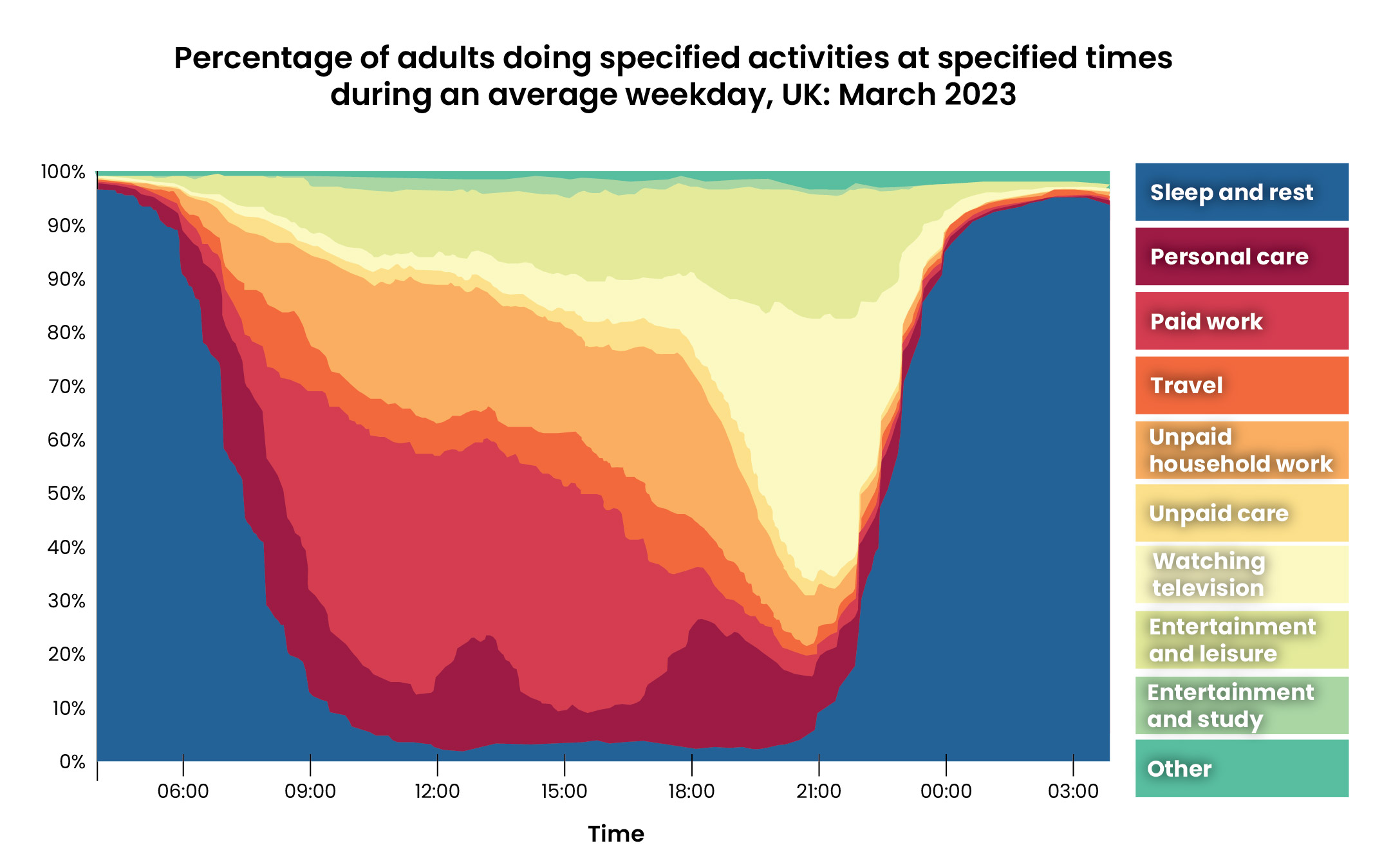
Work makes up a big part of people’s daily lives. Working age in the United Kingdom starts at age 16 years and continues to 64 years and beyond, with people working an average of 36.5 hours.2 Figure 12 below shows how adults in the UK use their time during an average weekday. Paid work (shown in red) accounts for a large proportion of this. What happens during this time will make a big difference to people’s health and wellbeing.
Figure 12: Percentage of adults doing specified activities at specified times during an average weekday, UK: March 20233
At a time when the local and national workforce faces serious health challenges, good work is more important than ever. Business leaders, major institutions and local employers in Derbyshire can make a difference to the future health and prosperity of our communities through committing to good working practices. So, what does “good work” mean?
The Chartered Institute of Personnel Development describes the key components of what good work means with its Good Work Index (see Table 3 below).
Table 3: Dimensions of the Good Work Index4
| Dimension | Areas Included |
|---|---|
| Pay and Benefits | Subjective feelings regarding pay, employer pension contributions, and other employee benefits |
| Contracts | Contract type, underemployment, and job security |
| Work-life balance | Overwork, commuting time, how much work encroaches on personal life and vice versa, and HR provision for flexible working |
| Job design | Workload or work intensity, autonomy or how empowered people are in their jobs, how well resourced they are to carry out their work, job complexity and how well this matches the person’s skills and qualifications, how meaningful people find their work, and development opportunities provided |
| Relationships at work | Social support and cohesion, the quality of relationships at work, psychological safety, and the quality of people management |
| Employee voice | Channels and opportunities for feeding views to one’s employer and managers’ openness to employee views |
| Health and wellbeing | Positive and negative impacts of work on physical and mental health, often considered as an outcome of job quality |
 So how can work improve health?
Work is a vehicle for better or worse population health. Improved working practices, working environments and investment in promoting health can provide contribute to better health of working age adults now and in the future. It can especially benefit those who already face social and economic disadvantage, who have disabilities or long-term health conditions. On the other hand, poor working practices can contribute to the burden of ill health that already exists and widen the gap in health outcomes. Table 4 below illustrates examples of this.
Table 4: The risks and benefits to health from work
 Improving Mental Health
Good work promotes good mental health by providing a livelihood, a sense of structure and purpose, opportunities for positive relationships and social interaction. Opportunities for personal development and achievement can lead to improved well-being and self-esteem. For those with existing mental health conditions, good work can also support their recovery.
Employers can promote good mental health in their workplaces, for example:
- investing in health and wellbeing, including occupational health
- assessing and managing stress
- acting to reduce stigma around mental health
- supporting the training of managers
- signposting to services and resources
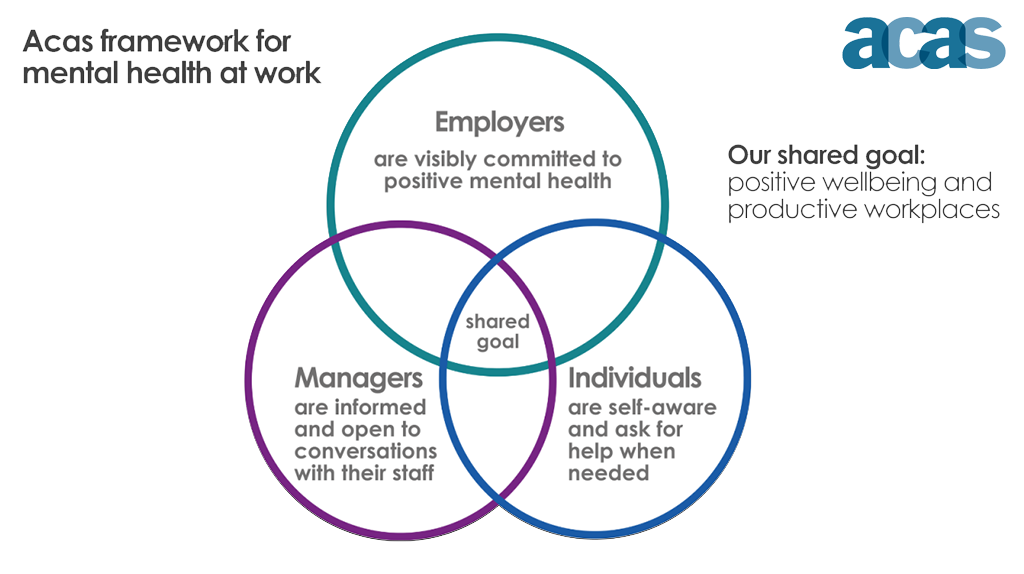
The ACAS framework below is an example of how employers can improve mental health and wellbeing at work.
Figure 13: The Acas framework for positive mental health at work5
 Improving physical Health
Good work can provide many opportunities to promote good physical health too. For example, flexible working policies can particularly benefit older workers and reduce the risk of heart disease.6
Many modern jobs no longer require people to be physically active. For example, in the transport sector or in office environments, employees may be required to sit for long periods of time, which can contribute to obesity, heart disease and diabetes. However, employers can promote physical activity through:
- job redesign to encourage people to move more.
- good ergonomic design to reduce musculoskeletal illness and injuries.
- policies, which incentivise active travel.
As a minimum, workplaces need to take steps to protect the health and safety of those who work for them and prevent serious injuries or illnesses, which prevent people from working. Investment in specialist occupational health and health and safety advice can address this.
 Improving Financial Wellbeing
Many working adults in Derbyshire face cost of living pressures despite being in work.7 Providing a living wage and stable employment (as opposed to insecure zero-hours contracts) provides people with financial wellbeing, which is fundamental to good health. Financial wellbeing reduces stress and promotes good mental health. It enables people to provide the conditions for their families and dependents to live healthier lives, for example through access to better housing conditions, nutrition, social activities and keeping physically active.
 Reducing health inequalities
Good work can reduce health inequalities by giving people a fair chance to access employment and keep them well to the end of working life. Employers can help by:
- providing a healthy and safe work environment
- good pay and conditions
- promoting health and wellbeing.
In the next section, the report will look at the barriers that people can face to getting work or remaining in work and what employers and other partners can do about it.
LISTENING TO DERBYSHIRE VOICES
Explore lived experiences from across Derbyshire. Discover how tailored support, persistence, and opportunity change lives.
Footnotes
Waddell G & Burton AK (2006). Is work good for your health and well-being?, London, TSO↩︎
Office of National Statistics (2023) Time Use in the UK: March 2023↩︎
Office of National Statistics (2023) Time Use in the UK: March 2023↩︎
Chartered Institute of Personnel Development (CIPD) (2024) CIPD Good Work Index survey report 2024: Summary Report and Practical Guidance↩︎
Acas (2023) Acas framework for positive mental health at work↩︎
Berkman, LF, Kelly, EL, Hammer, LB, Mierzwa, F, Bodner, T, McNamara, T, McNamara, T & Buxton, OM (2023). Employee cardiometabolic risk following a cluster-randomized workplace intervention from the Work, Family and Health Network, 2009–2013.American journal of public health, 113(12), 1322-1331↩︎