Chapter 4: Clearing the barriers to work
 Chapter 4: Clearing the barriers to work
Although some people are unable to work at all due to profound ill health or disability, those who can deserve the opportunity to have good work. Some groups of people require additional support to be able to enter work in the firsts place or to remain in employment.
You can hear more about how barriers to work have been overcome by reading and listening to businesses and residents from across Derbyshire. Click on the “Listening to Derbyshire Voices” section at the bottom of the page to find out more.
Work is good for people with disabilities and long-term health conditions as it empowers people to reach their full potential and gain control of their financial situation, leading to better quality of life. For those groups who already face worse health outcomes, such as adults with long term conditions, mental ill health, disability or neurodiversity, inclusive employment helps to reduce health inequalities and improve outcomes.
Working in an inclusive and disability friendly organisation is good for the health of all employees, not just those who are disabled. Inclusive employment practices improve retention of talented staff and increases staff morale. Happy workplaces are more productive. It also improves customer satisfaction and encourages repeat business.
 What are the barriers?
A typical journey out of work involves several missed opportunities for help:
- Poor working conditions and company cultures that do not prioritise health, such as not ensuring good job design, safety, reasonable adjustments, effective absence management, and flexible working.
- Lack of workplace support for people with health conditions or disabilities. Data from Department of Work and Pensions suggests that 29% of employers offer little or no health-related support, and only 45% of workers have access to occupational health or vocational rehabilitation services.
- Lack of financial security. Statutory sick pay is too low to provide financial security, forcing many to work while unwell or leave employment entirely. While some employers offer additional support, many do not, leading to uneven protection for workers and weak incentives for employers to invest in workplace health.
- A welfare system that is slow, rigid, and ineffective at supporting a return to work. Many people have a long wait before moving straight onto long-term benefits without access to rehabilitation or retraining opportunities.
- A disconnect between NHS healthcare and occupational health, and a lack of awareness within the healthcare system about the importance of supporting people with long-term conditions to remain in or return to employment.
- Personal circumstances such as caring responsibilities are often a significant factor in a person’s ability to take up work, particularly for older workers.
- Lack of educational attainment and opportunity, previous poor work-based experiences, health conditions and personal circumstances also create barriers.
Some groups of people have needs are not well understood and which create barriers to getting work or remaining in it. This chapter looks at three which warrant particular attention: people with neurodiversity, informal caregivers and young people without education, training or employment.
 People with neurodiversity
In recent years, many people have come to recognise that they are neurodivergent. Neurodiversity, while not necessarily a disability, can create many challenges for those who live with it. Common forms of neurodivergence include Autism, Attention-Deficit/Hyperactivity Disorder, Dyslexia and Dyspraxia. Individuals with neurodivergent traits often exhibit increased levels of creativity and innovation that can significantly improve levels of productivity. However, people who are neurodivergent often face challenges in terms of accessing employment in the first place. Without appropriate support of consideration, people with neurodiversity may be unable to show their full potential and may struggle to remain in the workplace.
Employers who supporting neurodivergent individuals to thrive at work can see significant benefits to their organisations, by harnessing the talents of individuals who think differently. Workplaces which understand and positively embrace neurodiversity can also support with recruitment and retention leading to organisational diversity that reflects the local workforce.
 Informal Caregivers
More people are having to care for family members while still working. In Derbyshire (including Derby City), there are estimated to be 118,000 unpaid carers.1 Carers UK estimated that 1 in 7 workers were juggling work and care, and 2.5 million people had quit their jobs to provide care, with half a million doing so in the previous two years. Many who had to quit their jobs said it was because their employers didn’t have supportive policies in place that would help them to balance work and caring.2 Employers and business leaders can change this situation for employees who balance work with caring responsibilities through carer friendly policies such as flexible working.
 Young People
Employers play a vital role in helping to give young people the best start to adult life. Young people without education, employment or training are at risk of having worse health outcomes. Recognising and addressing those who are most at risk will help to improve their outcomes. Derbyshire is part of a national pilot programme called the Youth Guarantee Trailblazers. This programme, which is funded by the Government and delivered in partnership with the East Midlands County Combined Authority, matches young people to job or training opportunities. The programme will help those 18 to 21-year-olds who are most at risk to find work and break down barriers to opportunity. The trailblazer will involve finding innovative ways to engage and support young people most at risk of falling out of education, employment or training.
Creating inclusive workplaces gives an opportunity for those with a long-term health condition or disability to benefit from work. It also supports their sustain employment. It helps to improve their health and reduces health inequalities. One of the first steps is recognising the barriers and taking steps to remove them.
 The Unique Role of Anchor Institutions
Inclusive workplaces benefit all workers and not just those with disabilities or health conditions. All partners involved with work and health, including employers, business leaders, NHS organisations and local authorities play a role in breaking down barriers and unlock the potential of all Derbyshire residents.
There is a special group of employers, called Anchor Institutions, which includes very large businesses, universities, local authorities and NHS Trusts. These organisations play an important role in improving the health of populations as illustrated in Figure 14 below. They do this through:
- being large employers
- providing training and professional skills development opportunities
- investment in the local economy as a large procurer of goods and influencing supply chains
- controlling large areas of land or buildings.
- large environmental footprint
- tied to a particular place by their mission, histories, physical assets and local relationships.3
Figure 14: How anchor institutions can influence health and wealth4
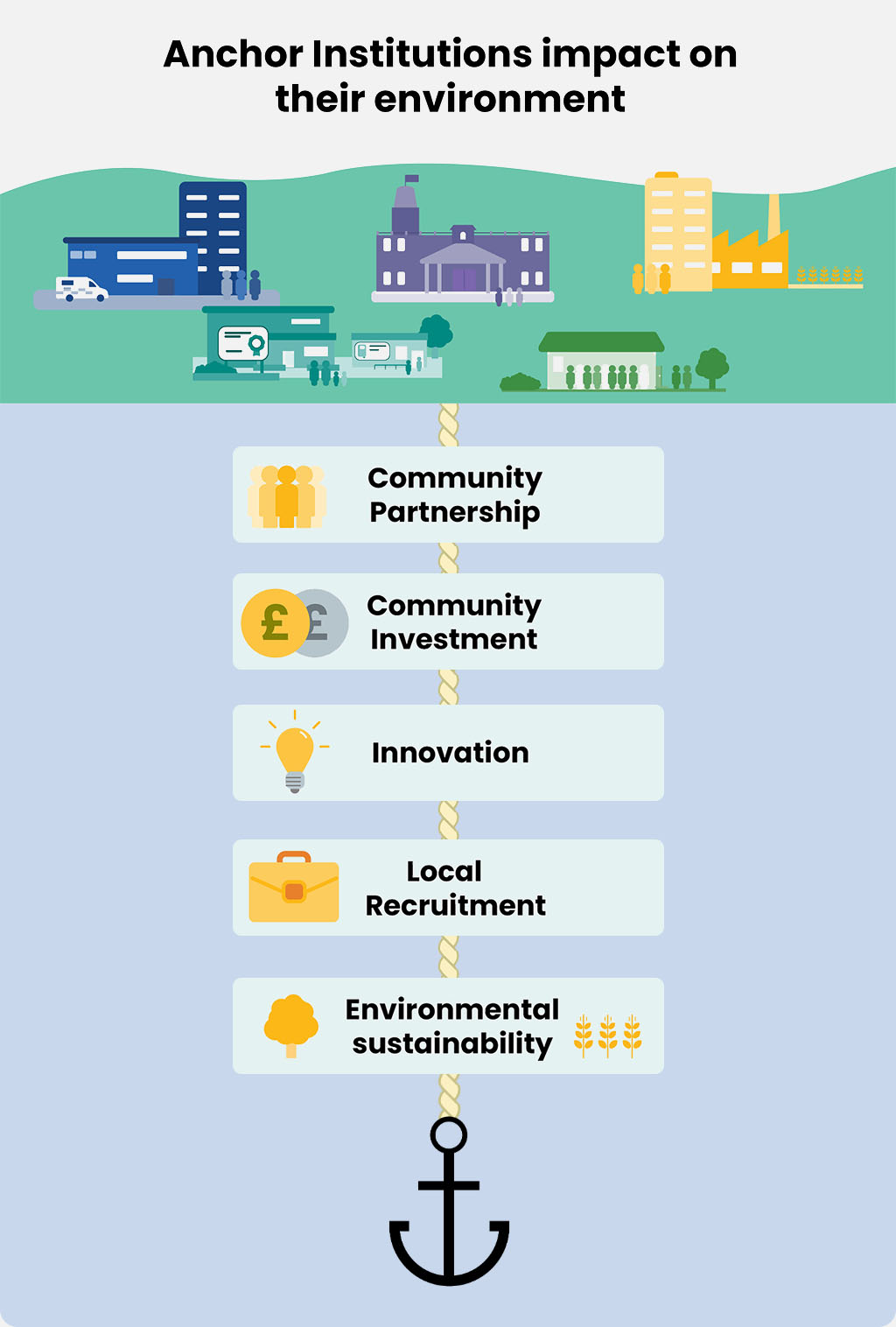
Anchor Institutions are often involved in political conversations that will have a big effect on local communities. Anchor Institutions often have a direct influence on the health and wellbeing of a large part of the population Anchor Institutions can set an example for other smaller employers to follow. In Derbyshire, in 2025, over 30,000 people worked for Derbyshire County Council alone.5 25,000 people were employed across the 4 main NHS trusts in Derbyshire (University Hospitals of Derby and Burton NHS Foundation Trust, Derbyshire Community Health Services, Derbyshire Health Care (NHS) Foundation Trust and Chesterfield Royal Hospital).6,7,8,9
Local authorities and NHS Trusts in Derbyshire play a pivotal role in improving the health of the population, and particularly that of working age adults. Local authorities and the NHS lead by example in providing inclusive workplaces, policies and organisational cultures, which keep their workforce safe and healthy and support those with disabilities or long-term ill health to enter or remain in employment.
 Summary
Good work improves the health and wellbeing of those who can access it. Getting access to good work in Derbyshire can really improve people’s health and wellbeing as well as providing empowerment, independence and future prosperity. This is particularly important for people who have long term ill health or disability who often feel excluded from work and are often dependent on welfare support. Voluntary work is often an important stepping stone for getting into paid work.
Support is there to help people to do this. Supported employment services bring benefit to those who are seeking to get into work and to their employers. Skilled professionals can match those seeking work to employment opportunities and help employers to realise the art of the possible when employing those who have greater support needs. The help is out there to support people seeking work and local employers to enable opportunities for all.
Everyone benefits from good work. Even those who feel that they have complex health needs or disabilities can benefit from access to work. Those employers who offered opportunities have reported significant benefits, including how it has improved the working environment for all staff.
In the next section, you will read about the business case for investing in health and wellbeing at work.
Before you read on, take a few moments to consider the word cloud in Figure 15 below. Think about the barriers that an individual might face if they have a disability or long-term health condition when trying to access work or remain in employment. Think about how your organisation could support them, for example, as an employer, business leader, educator or health care provider.
Figure 15: Barrier to Employment
LISTENING TO DERBYSHIRE VOICES
Explore lived experiences from across Derbyshire. Discover how tailored support, persistence, and opportunity change lives.
Footnotes
Carers UK, 2019, Juggling Work and Unpaid Care, a growing issue↩︎
Maguire D (2021) Anchor institutions and how they can affect people’s health↩︎
Garrod K (2023) Building wealth and wellbeing in our communities, Mid and South Essex Integrated Care System↩︎
University Hospitals of Derby and Burton (NHS) foundation Trust (2025), Apply for a job at UHDB↩︎
Chesterfield Royal Hospital NHS Foundation Trust (2025), Our organisation↩︎
Derbyshire Healthcare NHS Foundation Trust (2025) Who we are↩︎
Derbyshire Community Health Services NHS Foundation Trust (2025), Who we are and what we do?↩︎