| Workforce Profile and Risk Factors | Examples of employer actions | Examples of support from other sectors |
|---|---|---|
| • Predominantly male, often aged 25 to 55 | • Promote respiratory health (e.g. silica exposure awareness) | • Mobile NHS screening units at work sites |
| • Higher proportion of self-employed and small firms | • Musculoskeletal support (manual handling training) | • Tailored HSE sector guidance |
| • Lower formal education levels | • Mental health and suicide prevention programmes | |
| • Higher rates of manual labour | • Enable on-site NHS Health Checks or attendance of mobile screening units | |
| • Smoking, alcohol use, poor diet | ||
| • Low uptake of preventive health services | ||
| • High exposure to dust, noise, vibration |
Chapter 5: Why health at work makes business sense
 Chapter 6: A call to action
 A Shared responsibility
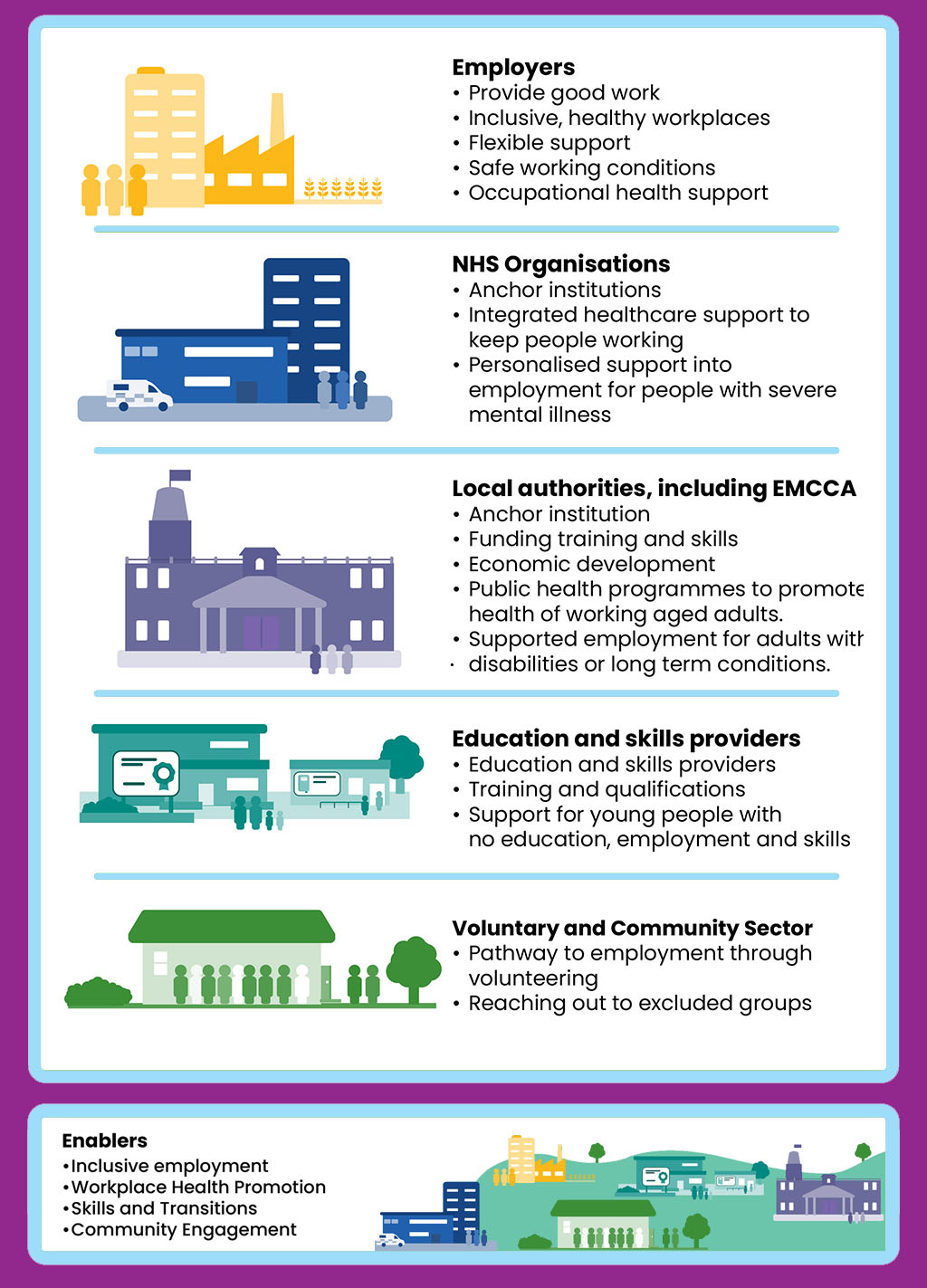
Improving the health of working aged adults is a key priority for Derbyshire and work plays an important part in this. This report calls on local partners to work together to make this happen. The report calls employers, business leaders, local authorities, NHS organisations, community leaders and educational providers to work together to make a difference. Figure 17 below gives some examples.
Figure 17: How key sectors and organisations can support the health of working age people
Click through the tabs below to see opportunities for employers from Derbyshire’s main industry sectors to work with other partners to support a healthy working age population.
 Construction
 Manufacturing
| Workforce Profile and Risk Factors | Examples of employer actions | Examples of support from other sectors |
|---|---|---|
| • Mixed age, often 35 to 64 | • Ergonomic assessments and Musculoskeletal disease prevention | • NHS-led workplace wellness pilots, |
| • Lower socioeconomic status in some sub-sectors | • Healthy eating and physical activity campaigns | • Health promotion outreach from public health teams and NHS (e.g. Live Life Better Derbyshire) |
| • Shift work common | • Shift-friendly mental health support | • Engage with occupational health and safety campaigns organised by the Health and Safety Executive. |
| • Higher rates of economic inactivity due to ill health | • Smoking cessation and alcohol reduction | |
| • Sedentary work or repetitive strain | ||
| • Poor diet | ||
| • Low physical activity | ||
| • Stress from production targets |
 Health and Social Care
| Workforce Profile and Risk Factors | Examples of employer actions | Examples of support from other sectors |
|---|---|---|
| • Predominantly female, often aged 30 to 60 | • Mental health resilience and peer support | • Sector-specific training from NHS and council |
| • High emotional labour | • Menopause and menstrual health support | • Provide shared counselling and wellbeing services for providers across Joined Up Care Derbyshire |
| • Part-time and shift work common | • Flexible wellbeing programmes (e.g. counselling, EAPs) | |
| • Diverse ethnic representation | • Flu vaccination and infection control | |
| • High stress and burnout | ||
| • Poor sleep hygiene | ||
| • Low physical activity due to fatigue |
 Retail and Hospitality
| Workforce Profile and Risk Factors | Examples of employer actions | Examples of support from other sectors |
|---|---|---|
| • Younger workers (under 30) and older part-time staff | • Accessible health checks and lifestyle advice | • Health promotion outreach from public health teams and NHS (e.g. Live Life Better Derbyshire) |
| • High turnover | • Financial wellbeing and stress management | • Health pop-ups in retail venues, |
| • Often low-paid and insecure contracts | • Flexible scheduling to support sleep and recovery | • Multilingual materials from NHS and council |
| • Ethnically diverse in urban areas | • Targeted health promotion campaigns | |
| • Smoking and poor diet | ||
| • Low engagement with health services | ||
| • Stress from customer-facing roles |
 Transport and Logistics
| Workforce Profile and Risk Factors | Examples of employer actions | Examples of support from other sectors |
|---|---|---|
| • Predominantly male, aged 40 to 65 | • Cardiovascular screening and diabetes prevention | • Engage with local workplace health promotion programmes from council and local NHS providers. |
| • High rates of lone working and shift work | • Sleep hygiene and fatigue management | |
| • Often lower educational attainment | • Smoking cessation and hydration campaigns | |
| • Sedentary lifestyle | • Mental health support for lone workers | |
| • Poor diet and hydration | ||
| • High stress and fatigue |
 the start of a conversation in derbyshire
A report by the Commission for Healthier Working Lives suggested that 82% of employers did not offer structured health and wellbeing support. But that means that 18% did!
Furthermore, over one in ten businesses already recognise that health and wellbeing is a top organisational priority.1 Those businesses, who have already made the investment in health will be making a significant contribution to improving the health and wellbeing of Derbyshire’s population. It is important these businesses and organisations share their experiences so that others can learn from them. If you are a business who has invested in health and wellbeing or work for a company that has done so, the Public Health team at Derbyshire will be interested to hear your story. You can send your stories, case studies and feedback on the report here: director.publichealth@derbyshire.gov.uk.
The public health team recognises the importance of work and health and is already engaging with employers and other partners to improve this situation. This report is the start of what will be a much bigger conversation with partners to improve the health of Derbyshire’s working age population.